A mark rising toward your lure
Often an interested fish. Keep your movements controlled and be ready for a bite.
Sonar tools can turn guesswork into informed decisions on the virtual ice. Here is how these displays usually work and how to use what they show.
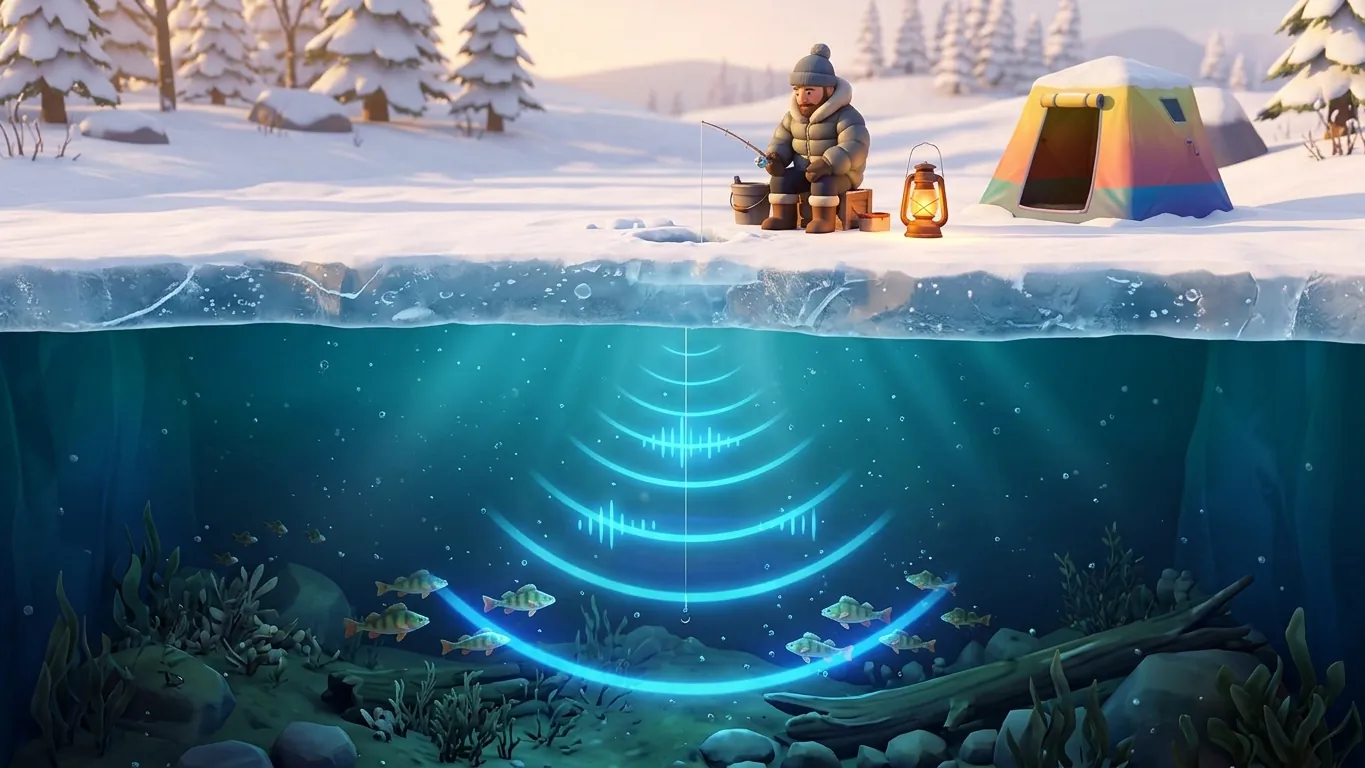
When you fish through a small hole, you cannot see much of what is happening below. Sonar, sometimes called a fish finder or flasher, gives you a window into the water column. In many ice fishing games it is one of the most useful tools, because it helps answer three key questions: how deep is the water, are there fish nearby, and how are they reacting to my lure?
Not every game includes sonar, and those that do may present it in different ways. Some use a circular flasher, others a scrolling graph or a simplified depth indicator. The underlying ideas, however, are often similar, so learning the general principles will help you in almost any title.
Most game sonar displays show the surface or ice at the top and the bottom of the lake at the bottom. The bottom usually appears as a thick, strong band. Its thickness or color can hint at whether the bottom is hard, like rock or gravel, or soft, like mud. Some games model this, others keep it purely visual.
Between the surface and the bottom is the water column. Your lure typically appears as a thin, steady mark that moves when you raise or lower it. Fish appear as separate marks that may drift, rise or sink. Weeds and other cover can show as fuzzy or uneven marks rising from the bottom.
Take time to identify your own lure first. Lower it slowly and watch how its mark moves. Once you can reliably spot your lure, it becomes much easier to see when a fish moves toward it.
These patterns appear in many games, though exact behavior varies by title.
Often an interested fish. Keep your movements controlled and be ready for a bite.
The fish may have lost interest. Try a smaller movement, a pause or a different lure.
Fish may be holding low. Lowering your lure closer to the bottom can help.
The spot may be empty. Consider changing depth or drilling a new hole nearby.
Likely weeds or cover, which can attract certain species in many games.
The real value of sonar comes from reacting to it. If fish appear several feet above the bottom, raise your lure to meet them rather than fishing below them. Many games treat fish as more likely to strike a lure presented at or slightly above their level.
Watch how fish respond to different movements. If a fish rises quickly when you jig aggressively but turns away before biting, try slowing down as it gets close. If fish ignore an active presentation entirely, a gentle shake or a long pause may work better. Sonar lets you test these ideas and see the results in real time.
Sonar also helps you decide when to move. If you have watched an empty screen for a while, the display is telling you something useful: there may be nothing to catch here right now.
Sonar is a tool, not a guarantee. Some games limit how clearly it shows fish, add interference, or require upgrades for better detail. Fish may also pass quickly, appearing only for a moment. Combine sonar with other clues, such as depth maps, time of day and the species you are targeting.
If your game does not offer sonar, you can still fish effectively by paying close attention to rod and bobber movement and by testing depths systematically. Sonar makes the process clearer, but your own observation remains the core skill.
 Choosing lures and bait in winter fishing games
Learn how jigs, spoons, live bait and other lures usually work in winter fishing games, and how to match your choice to species, depth and fish mood.
Read more
 Tips for finding fish under the ice
Practical tips for finding fish in ice fishing games: using depth maps, structure, drop-offs and a systematic hole-hopping approach on frozen lakes.
Read more
 Common winter fish species in fishing games
An overview of cold-water fish often featured in ice fishing games, including perch, crappie, walleye, pike and trout, and how games tend to model them.
Read more